Caring for Olive Trees: Pest and Disease Management
Olive trees are known for their resilience and strength, with the ability to withstand even fires. However, like all plants, they can be affected by pests and diseases. Often the leaves of an Olive trees appear ‘nibbled’. This is caused by a leaf beetle and is nothing to be concerned about. It is not detrimental to the tree’s health and hardly noticeable. Mealy bugs, on the other hand, can be a real problem, especially for indoor olive trees. These pests suck sap from the tree, and their presence can be detected by white, fluffy powder under the leaves and at the leaf axis. Early detection is key, and these bugs can be removed by blasting them off with water or wiping them off with alcohol or a soap solution. Despite these challenges, olive trees are generally quite resilient and can bounce back from most issues. Even if the tree loses all its leaves, with proper care, it will likely recover and thrive once again.
How to Water and Feed Olive Trees
Olive trees are known for their drought tolerance, and they can thrive in areas where water is scarce. However, commercial Olive groves often require irrigation to ensure that the trees produce high-quality fruit. In the UK, if an Olive tree is planted in the ground, it can usually survive on its own after the initial watering during the first growing season. But if it is grown in a container, it’s important to keep the tree well-watered during the growing season and ensure that it doesn’t completely dry out during the winter. While Olive trees can survive with minimal nutrients, adding a “tonic” of Tomato food to the soil in May and then again every 6 weeks throughout the growing season can be beneficial for trees grown in containers. This is not essential, but it can help the tree grow stronger and produce better fruit.
Pruning Olive Trees: A Guide to Proper Maintenance
Olive trees are known for their resilience and longevity, but they still need proper care to thrive. Pruning is an essential aspect of olive tree maintenance, as it encourages good leaf growth and helps develop the crown. In this article, we will discuss when and where to prune olive trees, as well as watering and feeding requirements, and how to deal with pests and diseases. When to Prune Olive Trees The best time to prune an olive tree is in late winter or early spring, just before the growing season begins. This is when the tree is dormant, making it easier to see and remove any dead or diseased branches. Pruning during this period also promotes healthy new growth and prevents the tree from becoming too bushy or overgrown. Where to Prune Olive Trees When pruning olive trees, it’s important to focus on developing the crown. To do this, start by pruning back each branch to a point where two or three new shoots will spur. This will encourage multi-shoot growth, leading to the development of a well-balanced crown. In the UK, open center pruning is less of a priority since olive fruit is not a significant concern. Instead, prune the tree to suit the available space. There is no science to pruning a tree outside of the commercial environment, and olive trees do not suffer from die-back. Therefore, you can prune anywhere without worrying about pruning just above a shoot.
MAINTENANCE/FAQS
Are Olive Trees Hardy? This is the number one question in the UK and there is a definitive answer – Yes. Olive trees are incredibly robust and can cope with a wide range of extremes. Villaggio Verde Olive trees are hard grown. All our trees are grown outdoors, not a poly-tunnel to be seen which means strength. No matter what the weather, our Olive trees experience it and that goes for a week of full hot sun right through to heavy snow. There are, however, certain things to consider. Do not let your potted Olive tree dry out in Winter. Here, at Villaggio Verde, we have seen very low temperatures in the UK over the past few Winters. It has given us the opportunity to further research how the Olive trees react to sub-zero temperatures. Villaggio Verde have studied this at our facility based in Worcestershire, middle England, and a few years ago saw the lowest temperatures for 100 years, minus 19.2! What we learnt from this was that the roots of an Olive tree can withstand being deep frozen for 2 weeks, providing the tree was hydrated prior to the freeze. In other words, the trees we left dry suffered more than the trees which were watered. During these extreme in low temperatures, we observed that the ‘dry’ trees suffered frost damage into the main branches and occasionally into the trunk, whereas the hydrated trees suffered less. A good hard prune the following spring encouraged the trees to bounce back. Olive trees are a little like Willow trees. Pollard or even chainsaw straight through the middle of the trunk, and the trees will start to shoot from the point where the tree was cut. Planting in the pots? Olive trees do extremely well in pots and can cope with being pot bound providing the crowns is kept cropped and in shape. You must also remember to water your Olive trees more frequently when in pots. Consider building a simple bottomless box around the base of your trees. This can be simply done using new sleepers (not old, contaminated railway sleepers), purchased from your local builder’s merchant. They are cost effective and easy to cut and put together creating a very attractive container. Make the sleeper container as large as you wish in order to balance the crown of the Olive trees. This also provides soil areas in which to under-plant with a herb for example. After one season, the sleepers ‘silver’ providing a super and cost-effective planter. Planting in the ground? Olive trees thrive when planted directly into the ground. They prefer alkaline soils and are happiest in poor soils, sandy, gravel types and chalk. They are also fine in any free draining soil. The trees also grown well in clay, however, our wet UK climate means if you have clay soils, you should consider how long it takes for the water to drain. This is easy to test, as you simply need to dig a hole, fill it with water, and see how quickly the water drains away. If it is still full of water after a few hours then imagine the roots of the Olive tree during the winter, probably too wet. You can help this problem, by only half planting the root-ball and then grading a freer draining soil from the existing ground level to the top of the Olive tree root-ball. If you choose to plant this graded soil with lavender, for example, then the tree will appear natural. Only part planting the Olive tree also means you retain some height, so the Olive tree is viewed and enjoyed even more.
General FAQS 2
What sort of soil and drainage do olive trees like? Olive Trees will grow at their best in a normal topsoil. Drainage is the main criteria for a happy health Olive Tree. Topsoil and compost mix can be used; however, soil holds moisture much better than compost. Good drainage can be acquired by using crocks and broken bricks/stones in the bottom of a pot/hole. The use of a French drain can also help if you are planting into poorly drained soil. How long will it take a young olive tree to grow to maturity? A young Olive Tree will have a smooth trunk, this will take many, many, years to change. I don’t want a tree that will grow too large – how large will an ancient olive tree grow? An Olive Tree trunk will not change substantially in this country. The crown will grow but will require an annual pruning in the growing season, this means you can choose how big your tree rows. Can I keep an olive tree indoors? Given enough light and the correct watering, olive trees thrive indoors. Large olive trees look fantastic in hotels, restaurants, shops and offices. Stunning in art galleries and make a lovely backdrop to shopping malls. Olive trees make glorious container trees for the home. And finally: “Olive trees – surely they won’t survive in the UK”! The trees we supply are Olea Europea and these are very well adapted to the UK climate. Remember that the Mediterranean winters can sometimes be as harsh as ours, so Olive Trees are no strangers to cold or even snow!
General FAQS

How to buy your Olive Tree in the UK? Olive tree specialist, Villaggio Verde has been promoting Olive trees in the UK for more than 20 years and are now the specialist Olive tree suppliers with more than 2000 Olive trees available. Villaggio Verde are committed to supplying ‘best value’ by keeping costs to a minimum. No ‘flashy’ expensive display areas meaning we simply offer quality and value Olive trees direct from ‘our door’ to ‘your door’. All you need to do is drop us an email. info@villaggioverde.co.uk Who do we supply with Olive Trees? Villaggio Verde supply Olive trees to a diverse group of plant users including the general public, garden centres, plants nurseries, mail order companies, garden design companies, construction companies, local authorities, country estates, high profile personalities and celebrities, television companies, film sets and some very important households! How will you deliver my olive tree? We offer a daily Olive Tree delivery, via a national pallet delivery service. Delivery is to the door/drive and is an all-day delivery with no time slot specified. The driver should call 1 hour before arrival. The tree will arrive on a pallet in a large lorry (dustbin lorry size) with a tail lift, please let us know if there are any access problems for a large vehicle. The vehicle does not have any lifting equipment, nor can the driver take the tree to your required planting destination. Please ask us about Saturday AM deliveries if required there would be an additional Saturday charge and a weekday AM delivery. There is also an evening delivery available between the times of 5pm – 9pm, however we do need to check with the individual depot for this service. Please ask about additional cost if any of these services are required when placing your order. For many properties access is limited and the only way into a garden can be either taking the tree (well wrapped) through the house, may be a side gate or sometimes up and over which may require a crane! If the latter is required, it is best you find a local contractor. we will of course always be there to offer advice to you or the contractor if required. We understand this is a large item to purchase and will always do our best to help inform you of a possible solution to getting your order to its destination as we have come across so many scenarios over the years. Lastly, I am certain before you place your order you will have thought about access, doors, gates, steps etc., weight/width of the tree and pot, and how you are going to move it. If you are unsure about anything, please call us to discuss it rather than receiving the tree and realising it is too big or too heavy for you to handle and take to its new home. (Office number 01886 887822) I live in London at the top of a block of flats – I want an old olive tree for the balcony, is this possible? Yes, it’s certainly possible, although it will depend on the load bearing of your balcony. Many of our deliveries in London require special logistics and this is no different. For a balcony tree, if the tree is too large for stairs and lift, it is possible for you to hire a crane locally and we can offer advice at this time. I want an old olive tree in a container on my patio – is this possible? Absolutely yes! Please make sure that there’s adequate drainage and that you’ve sited the container where you want it. Make sure the container is big enough to house the root ball of the olive tree.
Water, Water, Water !
In this blog, VV will be showing the importance of watering your tree. If your Olive Tree is looking a tad under the weather, give this a read ! Remember! You cant over water in a pot. If you need advise in regards to buying or caring for an Olive Tree, please get in contact 🙂 VV
My experience with Villaggio Verde & Building a raised bed for my Olive Tree – Alan VV Customer
THE SELECTION My wife has always wanted an Olive Tree to remind her of our many wonderful Mediterranean holidays. Having just moved house, it was a “now or never” decision and we chose NOW! We found a beautiful Olive Tree website called Villaggio Verde and with the help of Ben arranged a visit. It was Olive Tree heaven with hundreds to choose from and once we narrowed it down to “Ancient & Gnarled” farm manager JY escorted us to another farm for final selection. He was very friendly, helpful and gave us some key advice – “If you are putting it the ground build an enclosure otherwise you will lose the height!”. THE ARRIVAL It is a kerbside pallet delivery so make sure you have muscle available and access to its destination. We have an arched side path and VV confirmed it could be “wobbled” down the path. With the help of a couple of people we were able to lean it under the arch to its new home. TIP Very important you prepare the ground and get it to where you want it whilst you have help! THE FOUNDATION With the pot in place, we created a circular surround using log rolls and cleared an area wide enough to support a double brick wall. Filled some of the area with cheap ballast and concreted the remainder. TIP If you take your time getting levels across and inside to out, you can concrete to the top knowing the wall will more easily build on a level foundation. THE BASE Complete the first layer of bricks taking regular level checks. It is difficult to build without lines but knowing the foundation is level does mean that using the same height of mortar will create a level brick base. Given the tree is older than us, we decided to use even older reclaim bricks with the added advantage of not having to look perfect. A big bonus as I had never held a trowel in my life! TIP Chose to use yellow sand and white cement to give a light-coloured mortar. THE WALL With the first layer dry, time to cut the bottom off the pot whilst you still have access. Also split sides up to halfway. Fill first layer of enclosure and then build up remaining two layers. This height was just less than the pot, so we would not be losing the base of the tree in soil. TIP It’s important that the tree is in place at this point as we are starting to infill route. THE TOP With the pot removed as and the 3 brick layers dry fill in the enclosure with topsoil and stone. Now lay the final bricks sideways with slight slope into the enclosure. This will direct rainwater inside rather than down the outside of the brickwork. Once dry complete with topsoil and clean up brickwork. TIP As you fill up the layers use up your surplus materials like gravel, ballast, sand, garden soil etc. BUT NOT the cement!!!! It’s quite deep and you don’t just want expensive topsoil. THE ADOPTION Olive is now part of our Family Tree and readily accepted by our family and friends. It is older and wiser than all of us and will be thriving in its new home well after we move on. A true legacy bringing its charm and calm into the garden for future generations Hope you found this helpful as I struggled to find an example online. Many thanks to Ben and the staff at Villaggio Verde. They have been friendly, helpful and accommodating through this rehoming exercise! Time for an opening ceremony and a few beers! Hard work but worth it. OK that is the steps and done by a genuine retired amateur who had never held a trowel. Best Wishes, Alan VV Customer
RHS Chelsea Flower Show 2021
The Great Pavillion This content is private or does not exist. Enter password: Go – INFO 691ccvv-vpt 4 – pan… 691ccvv-vpt 2 – pan… 691ccvv-vpt 3 – pan… 691ccvv-vpt 9 – pan… 691ccvv-vpt 10 – pa… Tap here to start VR Please rotate the device into landscape mode and insert into your VR headset. Tap here to exit VR mode This page requires Javascript
RHS Malvern Spring Festival Gold Medal Winner 2019

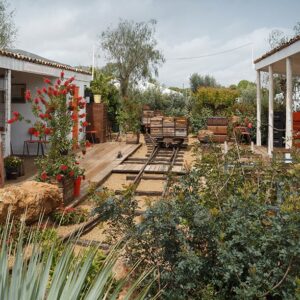
“The Orange Express” by Jason Hales of Villaggio Verde Proud winners of one of the 6 highly-coveted Gold Medals of this year’s RHS Malvern Spring Festival show garden. Villaggio Verde olive tree growers, took GOLD MEDAL at the RHS show in Malvern this year! Our beautiful award-winning garden was entitled “THE ORANGE EXPRESS”, evoking memories of rural Spain in spring, as visitors are transported to an old industrial working train station. The garden featured orange, lemon, pomegranate and olive trees sit alongside grape vines. The Award Winning garden included a train station house, a goods store and a railroad track, which gave the visitors the feeling of being part of the atmosphere as they viewed the scene from the platform. This year’s Golden Medal was one of the many we have received in the past. We are already looking forward to next year’s competition! Malvern Spring Festival – Gold Winner Show Garden – 2019 Malvern Spring Festival – Gold Winner Show Garden – 2019 Malvern Spring Festival – Gold Winner Show Garden – 2019 malvern-spring-festival-gold-medal-winner (2) (1) Previous Next 2019 – RHS Gold – The Orange Express 2018 – RHS Gold – Billy’s Cave 2017 – RHS Silver- Gilt – The Retreat 2016 – RHS Gold – The Garden of Romance 2015 – RHS Gold & Best in Show – Andalucia 2014 – RHS Gold – Balearic Islands 2013 – RHS Gold – Provence 2012 – RHS Silver- Gilt – Spain 2011 – RHS Silver – Spain